
VERTIGO
647-425-4669
Vertigo Resource Hub
Here you will find tools and resources to help with differential diagnosis of vertigo and dizziness.
Red Flags
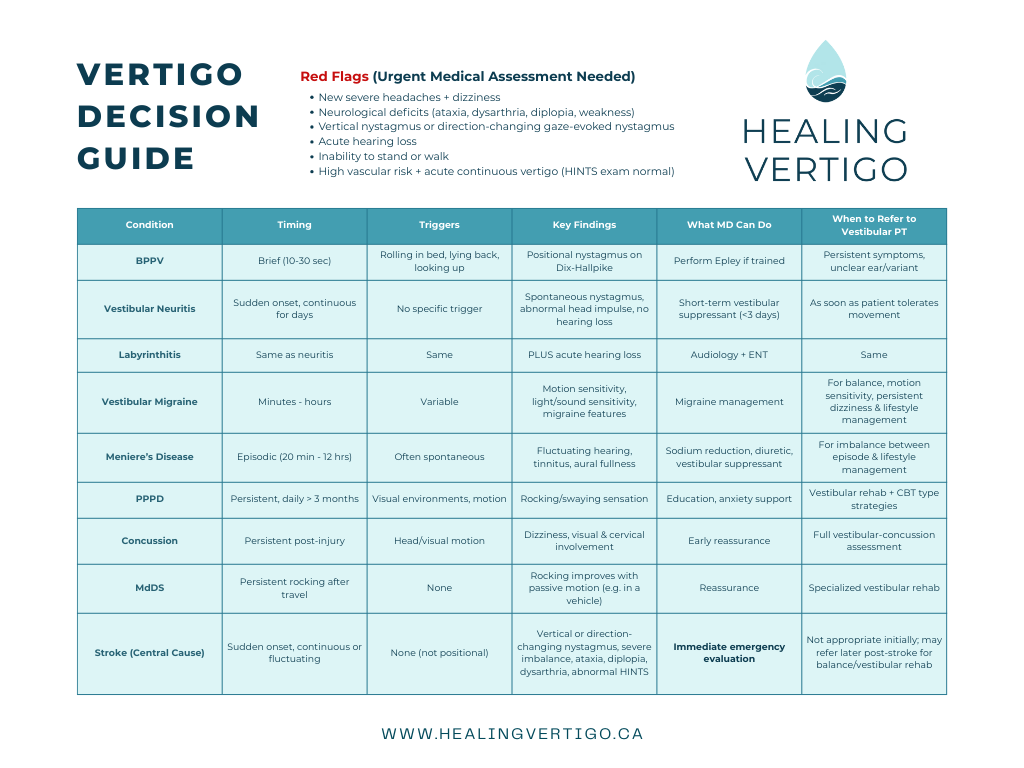
Vertigo Decision Guides
The HINTS Exam
BPPV Video Guide
Vestibular Physiotherapy Referral Form
Red Flags
(Urgent Medical Assessment Needed)
New severe headaches + dizziness
Neurological deficits (ataxia, dysarthria, diplopia, weakness)
Vertical nystagmus or direction-changing gaze-evoked nystagmus
Acute hearing loss
Inability to stand or walk
High vascular risk + acute continuous vertigo (HINTS exam normal)
Vertigo Decision Guides

Diagnostic Flowchart for Physicians

Wu V, Beyea MM, Simpson MT, Beyea JA. Standardizing your approach to dizziness and vertigo. J Fam Pract. 2018 Aug;67(8):490;492;495;498. PMID: 30110495.Download the full article here.
The HINTS Exam
Video curtesory of Dr. Peter Johns, emergency room physician from Ottawa, Canada.
BPPV Video Guide
Benign Paroxysmal Positional Vertigo (BPPV) is caused by displaced otoconia in the semicircular canals, causing positional vertigo, dizziness and nystagmus. Assessment involves finding the affected ear using the Dix-Hallpike test. Maneuvers, such as the Epley maneuver, help to move the otoconia out of the semicircular canal, resolving the patient's symptoms. Expect to need to repeat the manevuer 2-4 times.
Please note that not all BPPV is resolved with the Epley maneuver. If this doesn't work for your patient, please consider referring for further testing and treatment.
Step 1: Test using the Dix-Hallpike
Begin with the Dix-Hallpike Test.
Complete both the Right and Left Dix-Hallpike Tests. Take note of which causes the strongest reproduction of symptoms and observe for corresponding nystagmus.
Step 2: Treat using the Epley Maneuver
If the Dix-Hallpikes tests reproduced the patients symptoms and nystagmus was observed, treat using the Epley Maneuver.
If the Right Dix-Hallpike caused nystagmus: Complete the Right Epley Maneuver
If the Left Dix-Hallpike caused nystagmus: Complete the Left Epley Maneuver
If the Dix-Hallpike test did not reproduce symptoms, or the nystagmus presented atypical (horizontal with no torsion component or wasn't present in room light), please refer to Vestibular Physiotherapy for Infrared Video Goggle testing.
Step 3: Rest and Education
After completing the Epley Maneuver, allow the patient to rest in a seated position for 5-10 minutes until symptoms subside.
Provide the patient with reassurance and education around BPPV. Feel free to download and use our BPPV Patient Education Handout with your patients.
For additional BPPV instructional videos, click here.
Vestibular Physiotherapy
Referral Form
Vestibular Physiotherapy
Healing Vertigo offers vestibular therapy for all Ontario Residents. Connect to learn more about our services and book an appointment today!
Disclaimer: This advice is not meant to be a substitute for advice from a medical professional regarding diagnosis, prognosis, or treatment. Always seek advice from your physician, physiotherapist, or other qualified healthcare provider with questions you may have regarding a healthcare condition. The information of this website and email, including but not limiting to text, graphics, videos, images, and other materials are for informational purposes only. Reliance on the information on this website and email is soley at your own risk.